
The Reason Why I Wrote the Study Guide “Jesus’ Chronicles”
It is always very blessed for me when I look at the sequence of events or incidents as it occurs in the four Gospels of the Bible. The chronological order of incidents often explains why Jesus told certain parables or the way He reacted to incidents.
Jesus’ life and actions are recorded primarily in the four Gospels of the Bible: Matthew, Mark, Luke, and John. Some of the Gospels sometimes give exactly the same wording about an incident and sometimes a slightly different description. Similar incidents are cross-referenced in many Bibles in the four Gospels. The reader may then be under the impression that this is the same incident. In many cases, it is not the same incident and the time lapse between the incidents, which seems to be the same event, can be up to 3 years as where Jesus cleansed the Temple.
The Holy Spirit inspired me in 2005 and has been very faithful ever since to make a study of Jesus’ life on earth and to present all the incidents in chronological order with the four Gospels of the Bible as the main references and also other sources when needed. So, it was also possible to link dates to incidents.
However, it was no easy task. There are so many incidents that it is almost impossible to arrange them all chronologically and at the same time ensure that all the verses are included in all four Gospels. I then took a systematic approach, reading all four Gospels at the same time. The following clues helped me determine the sequence of incidents:
- Incidents such as the appearance of the Star of Bethlehem and information about it on the Internet;
- Seasons, months, and dates mentioned;
- Jewish Feasts and the dates when they were celebrated from the Internet;
- Time-lapsed words like “the next day” or “in the evening” to more hidden details like the reasonable amount of time it would take Jesus and his disciples to travel between towns on foot;
- Incidents described in more than one Gospel so as to synchronize events between Gospels. The challenge was to be sure that it was the exact same event.
Over a period of several years, I tried to determine the chronological order of the incidents in this way and was often completely confused. At one point I took note of a statement in Luke about the chronological order of events, recorded in
The challenge for me then was to synchronize the incidents in Matthew, Mark, and John with events in Luke. In doing so, I soon realized and came to the conclusion that the incidents in Mark and John were also recorded chronologically. In contrast, Matthew grouped events according to similar incidents and did not always record them chronologically.
By God’s grace, I was able to complete the study and assign actual dates, up to the nearest month in most cases, to all events recorded in the four Gospels. I ended with a complete list of every incident where every verse in the four Gospels was included.
I was very relieved then when I came across Fung’s14 doctoral thesis in 2022. “The meaning of ‘orderly’ (kathexēs) account in
Examples of Similar Events Recorded in Multiple Gospels Are Often Regarded as the same Event
1. Anointing of Jesus 3 times
- Event 79 according to Luke 7:36-50, during August 28 AD in the Capernaum area. Jesus had dinner with Simon the Pharisee while a sinful woman anointed his feet.Loading...
- Event 198 according to John 12:1-8, on Friday 31 March 30 AD, 6 days before Jesus’ burial, in Bethany. Jesus was at home with Lazarus, Martha, and Mary and she anointed His feet.Loading...
- Event 229 according to Mat 26:6-13andLoading...Mar 14:3-9on Wednesday 5 April 30 AD, 2 days before Jesus’ burial. Jesus was at home with Simon the leper in Bethany, and a woman anointed Jesus’ head.Loading...
2. Cleansing of the Temple twice
- Event 29 according to John 2:13-17, during the Easter of April 10, A.D. 27, Jesus first cleansed the Temple shortly after his ministry began.Loading...
- Event 204 according to Mat 21:12-14,Loading...Mark 11:15-17andLoading...Luke 19:47-48on Monday 3 April 30 AD, some three years later, Jesus cleansed the Temple the second time.Loading...
3. Jesus’ Rejected in Nazareth twice
- Event 39. According to Luke 4:16-30, Jesus was first rejected in Nazareth during December 27 AD.Loading...
- Event 97. According to Matthew 13:54-58 and Mark 6:1-6, Jesus was rejected by His people again in Nazareth during January 29 AD, about 1 year later.Loading...
4. Jesus repeated the Sign of Jonah 3 times
I was very unsure whether Matthew might not describe the same incident 2 times in
- Event 82 during December 28 AD, according to Matt. 12:38-45, one of the Pharisees asked Jesus for a sign.Loading...
- Event 113 during April 29 AD, according to Matt. 16:1-12andLoading...Mar. 8:11-21, the Pharisees and Sadducees again asked Jesus for a sign.Loading...
- Event 148 during November 29 A.D., according to Luke 11:29-32on Jesus’ last journey from Galilee to Jerusalem, the crowd began to get very excited. They may have hoped that he would now shake off Roman domination. Jesus then gave them the sign of Jonah to show that He was going to be killed.Loading...
5. More light on Parables told by Jesus.
This study guide, “Jesus’ Chronicles” definitely helps to better understand cross-reference in the Gospels. It sheds more light on statements Jesus made and why He told parables to refer to what happened beforehand.
- According to Event 207, the high priests, scribes, and other leaders challenge the authority of Jesus after He cleanses the temple.
- According to Events 208 and 209 follow Jesus with parables in which He makes them role players in the parables and alludes to them.
Main Objective of Jesus’ Chronicles
The main objective of Jesus’ Chronicles is to develop an aid that can assist someone in studying the “day-by-day” life of Jesus in chronological order. It should shed more light, truth, and revelation on each event recorded in the Gospels. By placing the events in chronological order, one can follow Jesus’ life chronologically as recorded by the four Gospels, and also physically by following Jesus’ travels on the attached detailed maps.
How Jesus’ Chronicles is Organized
In my study, I organized the four Gospels into 296 events along a chronological timeline. The timeline starts around 7 BC, about two years before Jesus Christ was born, and ends with the outpouring of the Holy Spirit with Pentecost on 27 May 30 AD. The 296 events across the timeline of approximately 37 years have also been organized into 7 broader periods or parts.
Commentary is also provided along with each event which explains, amongst other things, why the specific event follows the one before it.
Acknowledgments
I want to offer the following acknowledgments:
- The three-fold God of heaven and earth inspired me through His Holy Spirit to complete this study. There were times when I became discouraged and tried to give up. Then the Holy Spirit once encouraged me again to continue and move forward.
- My wife, Bessie, for all her support and understanding while the study took up so much of my time.
- My son, Benjamin, for all his help with the study, the language editing, and for hosting this website.
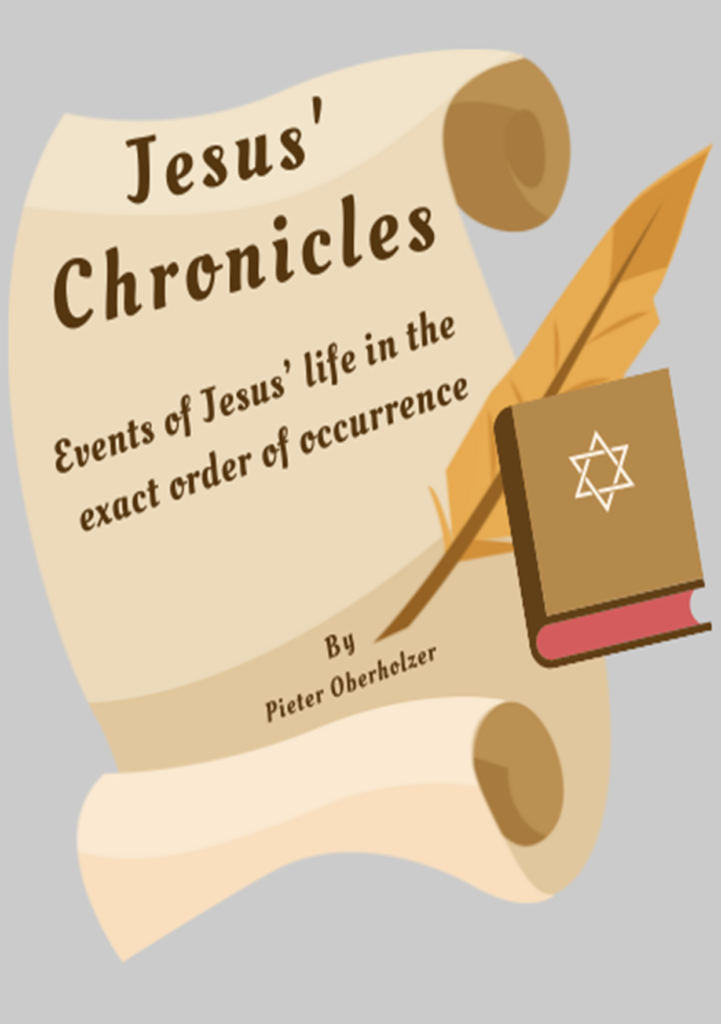
Cover page:
- The image of the Star of David on the Bible simbolises Jesus’ fulfillment of prophecies in the Old Testament. Seventeen verses in the New Testament describe Jesus as the “son of David”.
- The Bible’s New Testament contains all the historical events in the life of Jesus.
- The quill (feather pen) was used as a writing tool in ancient times.
- The scroll was made from the papyrus plant. It is a material similar to thick paper that was used as a writing surface. The Bible was originally written on scrolls.